COMPETITORS
AND CRAFTSMENBy Jeff Gorski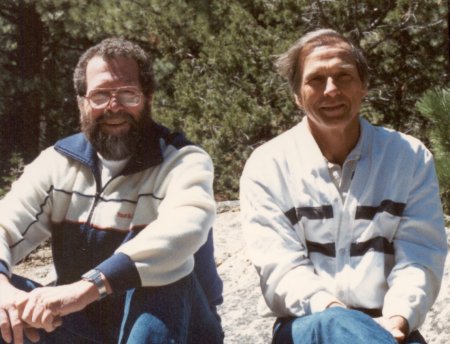
I first heard of Franklin
"Bud" Held and his brother, Dick, while a high school javelin thrower in New
Jersey in the early 1970’s. In studying the javelin at local libraries to learn to
throw farther I learned of the history of the event and the revolutionary contributions
both of these men made to it’s improvement. I remember the thrill I got when my high
school coach got me a 70m Held javelin as a senior with the cool Lakeside Supply label on
it- a little yellow shield shaped sticker with a javelin stuck in the ground. A decade
later I was an open thrower, on the verge of national ranking without a sponsor and met
Dick at the NCAA meet in Houston in 1983. He watched me throw in an empty stadium for an
hour from his favorite site- top of the stadium about half-way down field so he could
watch flight of the javelin. I was pleasantly shocked when a couple javelins from him
showed up at my home a week later.
I’ve been in touch with him since as a coach, athlete and fan of his work. He is a
great friend to throwers around the world, both for his design ability and willingness to
help out athletes with javelins for testing and use.
After being named Development Chairman in 1999, I wanted to run a camp for a dozen or
so throwers at the Olympic Training Center in Chula Vista and asked Dick to come along to
talk to the guys about javelin flight. He suggested I call his brother, Bud, who lives up
the road near San Diego. He gladly accepted the invitation and drove down to
spend the day talking with the athletes and giving advice. The brother’s Held were
joined that day by 1952 Olympic silver medalist Bill Miller, one of their old friends
from the javelin glory days of the US in the early 1950’s. Bud and Bill also attended
our first American JavFest in 2000. These fine gentlemen have great experiences that
they are willing to share and we are in debt to them for the fabulous stories and insite
they share with us here....thanks for everything, guys!!!
LSTJ:
When, and how, did you two get involved with the javelin?
Bud:
When I entered Stanford as a freshman I had never held a javelin in my
hand, and had only seen one once at a meet at San Diego State. I came to Stanford as
a pole vaulter and after landing on my head a few times in a rather hard sawdust pit, I
decided that the javelin might be easier on my body. By the end of my freshman track
season I threw 212' 10' at the Fresno Relays for the best college throw of that year.
Dick:
I was discharged from the Army Air Force in November 1945, shortly after
the end of World War II. Bud was in his senior year of high school. We made
plans together to enter Stanford University the following fall. Bud was one of the two
best high school pole vaulters in the nation so he had no trouble being accepted even
though there were thousands of returning veterans that year. He simply had to pass
the entrance exam. I, however, needed to rely on top exam scores to be accepted.
I signed up for baseball and Bud for track. A week before our first game I
was called into the athletic department office and told the good old NCAA had ruled I
would lose a year’s eligibility through a technicality. At the time I was
starting right fielder and a backup pitcher. A little angry, to put it mildly, I
stormed over to the admissions office and withdrew.
Bud continued in track but kept asking Jack Weirhauser for a chance to throw the javelin.
Finally the constant badgering got to the coach and he set up a competition between
Bud and his vault coach Cornelius Warmerdam, neglecting to tell Bud that Warmerdam had
been a top collegiate javelin thrower in addition to his vaulting prowess. Bud was
promised that if he won he could throw the javelin as a separate event. The rest is
history. A few weeks later Bud won the West Coast Relays against top open throwers
with the longest collegiate throw of the year.
LSTJ: What were your athletic backgrounds? Neither of you threw the javelin at
an early age.
Dick:
When Bud was four and I was five, Dad bought us gloves and a baseball.
He usually spent an hour a day teaching us proper throwing technique. We built a
pitching mound and installed a plate at the regulation distance. Bud and I threw to
each other whenever we had some spare time, alternating pitching and catching. I was
standing on the mound when Grandfather interrupted us with the news of the Pearl Harbor
bombing. We had both acquired a full arsenal
of pitches by then. Since there were no baseball teams nearby we started playing
championship caliber AAA and AAAA fast pitch softball. Bud was twelve and I was
thirteen. We were playing on one of the best adult teams in Southern California.
Our catcher was a retired major league catcher for the Cleveland Indians. He
once told us Bud was faster at seventeen than fireballer Bob Feller had ever been.
LSTJ: Bud, give us a feel of what the "track world" was like during
your top years; travel, meets in Europe, the general attitude of athletes as opposed to
that of today’s ‘stars’.
Bud:
Track and field was truly as amateur sport in my day. No athlete,
except perhaps Wes Santee, expected to make any money from track, and he was banned by the
AAU. We were limited to $35 expense money per day and were not allowed to accept any
prizes or gifts valued over $35. The trips and the competition were the rewards.
LSTJ: Dick, when did you get into the design aspects of javelins? Give us some
background on what you did in experimenting with them- materials, designs that were good
but ‘pushed the limits’.
Dick: Bud threw the Karhu wood javelin from Finland. Good ones were hard to
find and expensive for a married grad student so he began rebuilding his own. His
inquisitive mind quickly pushed him to develop improvements. The 1953 world-record
was set with a modified Karhu. The slender front section had been replaced with
a larger section taken from the center of another implement.
Thus the first javelin with a larger than normal point evolved. He also built a
couple of javelins with normal size grips and three inch diameter front sections.
These were made of ash, so to keep the weight to the regulation 800 grams they were
hollow. One of these is still on display at the Eugene OTE plant. Bud actually
built the first hollow javelin I ever saw. He refined his implement and set up a
practical method of hollowing the javelins.
About December 1953 or January 1954, Bud called me and explained what he was doing.
He told me he did not have time to continue his experiments as training and classes
were leaving him with no free time. He asked if I would take over building
implements for him. At that time neither of us envisioned a commercial operation,
just a source of good javelins for American throwers so they could compete on an even
field with the Finns and their supply of javelins.
I caught a train to San Francisco and Bud gave me his work in progress. I returned home
and began to hand build some new models. Our home was in the very small town of
Lakeside, California. A local recluse and his son lived back in the wilderness of
Wildcat Canyon. This man came into our hardware store and was very friendly with my
father so I had learned that he built flight bows. His son could shoot an arrow
further than anyone else in the world. I visited him and he showed me some of the
most beautiful bows I had ever seen. However I was more interested in arrows.
He showed me arrows which traveled over a half mile and demonstrated some for me.
I learned the type of wood, its source and seasoning. I modeled those first
javelins after competition flight arrows. They were made of Port Orford Cedar, cut
from standing trees, killed many years before by a fire.
During the Spring of 1954, I brought about six new javelins to each major meet where Bud,
Bill Miller and Cy Young were throwing. The best performer was copied and six new
ones were built for the meet the following week. This process continued for about six
weeks until thirty or forty javelins later, I settled on a design. Six were
available for the NCAA and AAU meet that year.
A kid from Kansas and Al Cantello had great performances with one at the NCAA with two
or three meet records and a new NCAA record by Al on his last throw.
I was an electrical contractor at the time with a large business which took at least 60
hours a week. This was all done as a "spare time" hobby. Airlines were not
what they are now so a lot of time was spent on trains and Greyhound buses in those years.
Eventually a thrower on the European tour remarked in an interview that Bud had an unfair
advantage since his javelins were unavailable to others. This was not exactly true as both
Bill Miller and Cy Young were throwing them. The interview was published in Track and
Field News. I immediately sent a letter to the editor that was published in the next
issue. I offered to supply one to any thrower wishing to pay $35, about twice the
going price of the old model Karhu. I didn’t expect any takers and was greatly
surprised the following month, when orders began to pour in from places like Oregon,
Pennsylvania, New Jersey, Germany, Finland, France and other parts of Europe.
Orders were filled in my spare time using the family business, Lakeside Supply Company, as
a sales outlet. We checked with the IAAF concerning it’s rules, first. I
purchased my brother’s interest in the business to protect his amateur standing.
The IAAF was okay with the name Dick Held on the javelin so the operation was up
and running. It peaked in 1966-68 with six thousand aluminum javelins produced per
year. The wood javelins were phased out after the Olympics in Japan. They
ordered 64 wood and 64 aluminum javelins, all of which following my custom, were provided
at no charge. The only ones used were the aluminum models. I was told that as much
as twenty years later those wood implements were still stored in the stadium in perfect
condition.
All the development and innovation prior to 1964 was done by Bud and everything after that
was my work, in keeping with the Olympic and IAAF rules on amateurism at that time.
LSTJ: What was it like during the "trial and error" time when you were
designing and throwing the new javelins? Who else were your "guinea pigs"
for this?
Bud:
I began experimenting with modifying the Finnish Karhu javelin while at
Stanford in 1949. I was getting better flights by 1950 and my throwing
friends and competitors Bill Miller and Cy Young wanted one. I made up two
modified Karhus and gave one to each. Making them was a lot of work and I
could not sell them because of amateur rules. It looked like there might
be a market for them so I asked Dick if he wanted to make and sell some. He
obliged with amazing skill and made up many new and improved models.
Dick:
During the period between 1954 and 1960 the IAAF made several rule changes
aimed at the Held javelin but each time I was able to bring out a successful design within
the new rules. Bud and Bill Miller tested many of the experimental models.
Later, Larry Stuart was kind enough to do the throwing tests on the model built
after the 1960 rule change. Frank Covelli and Ed Red were great helps during the
1960’s. Frank tested an early attempt at building an exceptionally stiff model
similar to the present carbon implements. It, however, proved too stiff and was
discontinued because of the danger to shoulders and elbows.
During the late 1950’s U.S. scientists were having trouble stabilizing the flight of
early ICBMs. Dr Richard Ganslen was high up in the program and contacted me to ask
how my javelins achieved stable flights. That design feature was disclosed after
many long distance phone calls between myself, Dr. Ganslen and a German rocket engineer.
It was incorporated in early ICBM’s before the present day stabilization
systems were developed.
In 1974 the old javelin stabilization system was abandoned and the Custom I, II and III
models developed. They were more erratic and required better technique but when
thrown properly, achieved great distances. Petranoff and Uwe Hohn’s world
records were the climax of that javelin series.
LSTJ: Both of you are pretty inventive guys- besides the obvious javelin related
stuff what have either of you turned out that was a challenge for you?
Dick: During my teen years I invented a system of attaching a plow to track laying
tractors which was used by local citrus growers. However, the track laying tractors
were being replaced by wheel tractors about that time so the system was never patented.
In 1972 I began to design and manufacture kayaks and canoes. This was very
fulfilling since I turned out to be a natural at marathon canoeing and kayaking. At
the age of fifty I began whitewater marathon racing, several times placing in the top ten
at National Championships paddling my own design. My last race was the Tahoe
Criterium at Lake Tahoe in 1987. I entered as a veteran for the first time and
easily won the event which was included in the men’s open race. I actually won
the open by a boat length, paddling my own design. One of the entrants was the top
US marathon boater, however he pulled out with respiratory problems so I never knew if I
could beat the best in the USA at 61 years of age. Those years between 50 and 61,
racing with the best, leading groups through the Grand Canyon, the River of No Return and
Lodore Canyon and becoming known as a person who could run any whitewater river, were
grea. Even if I was thirty years older than anyone else, I gloried in embarrassing the
twenty and thirty year-old competitors.
LSTJ:
What do you guys feel is the most critical aspect of throwing far? If
there’s more than one, how about ranking them.
Dick:
This, I will leave to the people who are trained in coaching and throwing.
Bud:
I think the most important element of throwing is keeping the body momentum
going forward and up into the throw, and, of course, transferring that momentum into the
javelin during the actual throwing motion.
LSTJ:
For both of you- what areas of throwing do you feel are lacking the
most here in the US? What can we do to improve this?
Dick: Our best athletes go into the glamour sports. Money and publicity draws
them to football, basketball and track. Only a few, like Bud, Tom Petranoff, Tom
Pukstys, Breaux Greer, Al Cantello and the rest of the forum contributors would turn down
a contract to play quarterback or pitch in the Major Leagues for a sport with little or no
chance of earning a living.
Bud: I believe that
the major reason that the U.S. does not have more good throwers is the money
available in other sports such as football, basketball and baseball. I had an
opportunity to play professional baseball, but the salary levels at that time were not
enough to entice me away from my education and career interests. At the salary
and endorsement levels today, I probably would not have resisted the temptation.
LSTJ: Both of you have seen a lot in the javelin world; what was
the most impressive throw you guys have seen? In that same regard- what’s the
most impressive athletic feat you’ve seen?
Bud: Of all the throws I have witnessed in person, two that Al Cantello made at
Compton in the mid 50’s impressed me most. I was having trouble reaching
250’ in poor crosswind conditions when Al popped two throws out over 280’, both
for world records. It turns out Al had been lifting weights, something that throwers
just didn’t do in those days.
Apart from javelin throwers, the most impressive athlete I ever saw was Dutch
Warmerdam. Dutch was my vaulting coach at Stanford, and while he was long past his
competitive days, he used to occasionally get his spikes and a bamboo pole out of the
storeroom and show us how it was done. He would put the bar up to just under
15’. When he came down the runway it was an absolutely smooth and flowing
motion. I think he could have balanced a glass of water on his head. When he
took off there was no jerking of straining. He just seemed to rise up in an
effortless fluid motion and sail over the bar. I remember thinking it was like the
wind blowing a feather down the runway and then with an updraft sweeping it over the bar.
Dick: Two throws that I have witnessed in person were Bud’s 1956 throw at
Occidental with a wood javelin. He had already broken the US record with a 270’
and the next one went far beyond anything anyone believed possible. It landed eight feet
high in the bleachers, six inches outside the sector. Not legal, but what a throw.
The distance to the landing spot was 297’. Had the bleachers not been in the
way, it would have gone about 310’. This was a time when the World Record was in the
low 270’s. It did not reach 300’ until over twenty years later at the 1968
Mexico City Olympics. The other was Tom Petranoff’s 327’ at UCLA.
You knew it was a world record fifty feet after it left his hand. I stood
there yelling "Come over damnit, come over." When it hit point first I was
probably more elated than Tom.
Dick: Bud, give us a bit of a history lesson- who were your toughest competitors,
both U.S. and overseas, and what were their special abilities that made them dangerous?
Bud: Cy Young and Bill Miller were my two major competitors. Cy was just
big and strong, and Bill was quick and agile and an amazing athlete. I remember
watching the results of a national decathlon competition that Bill decided to compete in a
few months after he had surgery for appendicitis. I was amazed at his high jump
result of 6š 10˛, the highest I had ever seen for a decathlon.
LSTJ: Dick, the javelin world has seen a lot of changes and adjustments
regarding rules and design: who were the throwers that got the best use of the different
javelin designs?
Dick: Bud was the best with the wood implements. Al Cantello was probably the
best with the early, large diameter aluminum model. Tom Petranoff was the master
with the Custom II and III. He listened when I told him how it needed to be thrown,
then worked until he could handle it. I have only seen Zelezny a few times but he is
all by himself at this time. Breaux can join him with a little luck and a lot of
work. He has what it takes.